Bonsai for the Layman

BONSAI FOR THE LAYMAN

Bonsai is the art of growing ordinary plants in shallow pots by the selective application of some common principles of horticulture and techniques of gardening to bring out the natural beauty of the plants and create a look of age-old maturity in them. This scientific art and the plants cultivated through it are both termed as bonsai. The fascination of bonsai is capturing the imagination of everyone these days. It has gained popularity, as it is eminently suitable for today’s lifestyle especially of city-dwellers in their search for greenery.

For some reason, a few misconceptions about bonsai are also prevalent – that they are tied with wire to prevent their growth; or that they are given just a thimbleful of water and are generally starved to remain stunted. I would like to make it very clear at the outset that this is not true. Wire is wrapped only to alter the shape of the trunk and branches in order to conform to a natural shape. Bonsai are watered thoroughly at least once every day depending upon the climatic conditions and they are also fed nutritionally from time to time. In fact, all bonsai growers lavish a lot care on their bonsai and pamper them as if they were children or pets.

I think that misconceptions such as the above arise mainly due to the reason that the layman has a misplaced idea of cruelty to plants usually born out of seeing oddly shaped, distorted plants displayed in nurseries which do not even know what a bonsai is but are eager to cash in on its glamour. A layman is therefore most likely to be misguided and is far from being able to find correct scientific information or to actually learn the techniques of bonsai; the layman is therefore deprived of the enjoyment of nurturing and viewing bonsai. For such people, I give here some simple tips and pointers that will dispel the misconceptions and induce them to grow bonsai on their own. After all, it is man’s love for nature which leads him to discover newer ways of keeping nature nearer to him in today’s fast growing concrete jungles and disappearing greenery.

What is bonsai – Bonsai are nothing but common plants shaped to look like their bigger counterparts in nature, having all the attributes of foliage, flowers and fruits like mature trees and aesthetically looking like common trees in nature. But then, how do bonsai come into being? Let us see………

Material The techniques of bonsai can be successfully applied to any ordinary woody plant material. There are actually no special plants for bonsai. Any ordinary plants from a number of plant species to choose from can be made into a bonsai. But those with naturally small leaf size are better and have a better chance of being convincing as a miniature tree image. Plants normally grow from seeds which can normally be found anywhere or are also propagated artificially from cuttings, air-layers amp; graft in nurseries the world over. Material for bonsai can be obtained from any of the above sources i.e., from common nursery grown plants or seedlings (both newly germinated saplings amp; thick, mature plants) or collected seedlings/plants/trees from the wilds. It is however easier for the layman to select plants from a nursery for their first attempts in bonsai as these will have an already established root-system used to growing in a small, compact container and will not involve the hardship of propagating and nurturing seeds/cuttings/grafts, etc.

Selection of plant– Choose a plant with thick woody stem but small stature. If possible the plant should have good, attractive foliage, all-round root spread, a tapering trunk amp; a profusion of branches distributed along the length of the trunk line.

Creating a bonsai

If you have ever observed the natural forms of trees around you, you may have seen that most tree species conform to some commonly recognizable genetic shape, e.g., tall straight trunks of Ashoka, rounded shapes of Mango trees, the fan-shaped appearance of Pipul trees, the flat umbrella type growth and aerial roots of the Banyan (Vad), etc. So, trees may essentially be similar but the genetic forms and shapes are different from specie to specie. Plants bought from nurseries, seedlings and dug out plants need to resemble with one of the basic shapes mentioned above. Or one may have to wait till a given plant gets such a shape or choose another plant which has such a shape. Once it is seen that the plant has one of these basic shapes its training can be started.

Training– Initially, cut short the top growth of the plant to make it look shorter and to emphasize the relative thickness of the trunk. Also, cut off the branches which look un-necessary and cluttered and are crossing each other. If necessary, change the shape of the trunk by gently wrapping it from base to apex (tip of trunk) with an ascending spiral of aluminum wire of a sufficient strength and then slowly but firmly bend it to a shape which conforms to the tree forms seen in nature. Shorten the length of the top branches so that lower branches appear bigger and longer; if necessary, wire the branches also so that their shape may be altered by gently sloping them downwards. If there is a flow to the trunk then a similar flow should be maintained in the branches also. The shape of the plant should look natural and not tortuous.

It is also possible to commence training in stages by letting the plants grow initially in bigger containers, periodically pruning them without materially altering their recognizable shape and watering amp; feeding them regularly so that over a period of time the plant becomes thicker and mature, a basic pre-requisite of a bonsai. This is a matter of choice and certainly of greater patience. After the plant resembles a mature shape either naturally or by changing it through wiring and pruning, it can be transferred to a flat ceramic of earthen container as you would plant any other plant provided you use a soil textured to be well drained. Normally, only red earth/soil are not used alone for bonsai but a quantity of organic material and draining material (such as brick crush or granular river sand) are mixed in a generous proportion to the soil. Choose any of the recognizable tree shapes mentioned above but take care not to force the plant to grow in a style which is not natural to it. Bonsai is supposed to be an aesthetic statement, not a horticultural oddity.

Maintenance– The bonsai will need only daily watering and exposure to sunlight (at least 2/4 hours a day), monthly fertilizing and pruning and re-potting after 1 to 3 years depending on its growth rate.

General– As most specie of woody plant material needs at least 2/4 hours of sunlight, it is advisable to keep bonsai outdoors only. Of course, they can occasionally be displayed in your drawing room, but care must be taken not to expose it to extended periods of air-conditioning
or excessive heat. The tree must also be checked to see if wire wrapped round the trunk/branches are not cutting into the bark and if needs be, are to be removed; wire is not applied as a fad, it is there for a purpose- the purpose of altering the shape of the part which is wired. Once the purpose is served (maybe in one season or one year or more, as necessary), the wire need not be kept on the tree. Fertilizing has to be a regular monthly feature (preferably half the recommended strength), daily watering a routine and pinching of new growth and pruning of cluttered amp; crossing branches a habit.

Please remember, nothing which is worth human effort is easy, keeping a bonsai more so as it is a commitment – just like keeping a pet. It will need constant care. But if you give it this care and attention it will definitely reward your creative instinct with green foliage, flowers and fruits, depending on the specie.

It is also my first-hand experience that bonsai are the best stress relievers and will teach you to live in harmony and peace not only with nature but also with your inner self, assets which are getting scarcer in today’s stressful lives but are so easily within our reach.

Plant material for Bonsai

RAW MATERIAL FOR MAKING A BONSAI
The creation of bonsai requires raw material in the form of plants. All plants with woody stems having a good network of branches and which adapt well to hard pruning are suitable for bonsai. Container grown nursery plants are more suitable because of their compact root system. Plants for making a bonsai can be either self-propagated or container grown or collected from the wilds. All the plants are a product of vegetative propagation one way or the other. They are propagated either by seeds, or by cuttings, air-layering or grafts.

For that matter, grafts are also cuttings propagated in a special way. As bonsai are also ordinary plants in every way, raw material for a bonsai is also obtained from any of these methods. Sometimes plants are collected from the wilds, but these are also seedlings which most times grow in inhospitable conditions and are shaped for a long time by nature and therefore have a more natural form than that given by man. Nursery grown plants are also either seedlings or air-layerings or grafted material. When choosing material for bonsai one must select only those plants which have a lot of branches and have a tapering trunkline as a starting point. These characteristics are sure to ensure that such a plant will eventually make a presentable bonsai in a reasonably short time.

The main options for plant material are, however, collected plants and nursery plants.
Collected plants 
Colleting of plants from the wilds is a difficult proposition. Firstly, the collector has to obtain the consent/permission of the property owner/govt. authorities or sometimes permission may not be required. Secondly, the chances of survival for the collected material depends on several factors such the species of the plant, season of collecting, the amount of rootage remaining after collection, the balance achieved between foliage amp; rootage, the conditions which are provided on transplanting and of course the skill of the collector. In most climates, the best time for collecting is early spring. Dig up as much of the root ball as is possible, wrap the roots with damp sphagnum moss or gunny cloth (similar to hessian) and wrap up the whole plant in plastic sheeting to prevent dehydration. Cut off the top growth as much as possible to match the reduced rootage, keeping the future design of the tree in mind.

Plant the tree as quickly as possible in a large pot or planter box using coarse sand or similar fast draining material; water it thoroughly and keep it in a semi-shaded location, i.e., neither too much shade nor too much sun. Do not prune or otherwise disturb

the plant for the next year or so letting it grow unchecked to recoup its energy. Intervals between waterings too need to be monitored closely; keep the soil moist but not soggy.. Feeding with fertilizers can be started only when consistent growth is observed. Training or pruning can commence only after rank growth is achieved ensuring that the roots have taken hold. In some cases it may take three/four years for a wild plant to adjust to cramped quarters before any major shaping process can be undertaken. (Tip – Be careful; too much water to a plant used to surviving in a more or less dry condition can lead to root rotting).

Nursery plants

As creating bonsai from nursery stock is by far the easiest method, we will confine ourselves to this source of obtaining material for creating bonsai, although the guidelines will equally apply to material from other sources as well with minor differences.

In order to convert a nursery plant into a bonsai, the first consideration will have to be prolific number of branches growing all along the trunkline and in all directions. The second priority should be good rootage. This is not a problem with nursery stock.

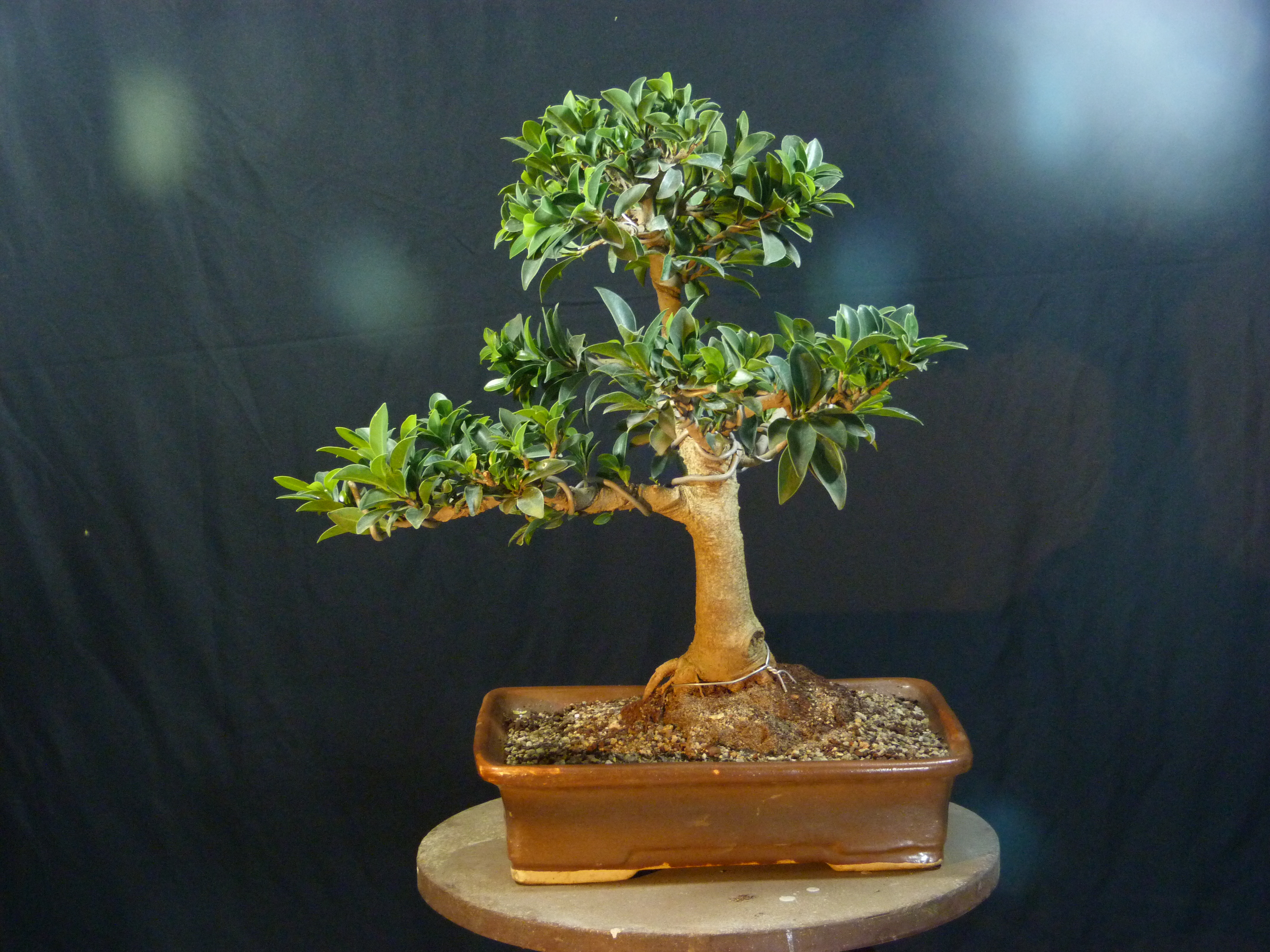
Once a likely plant is chosen, the plant should be viewed from all directions to determine the movement of its trunk in order to determine the style characteristic of the tree. If the trunk is ramrod straight, it can be a bonsai in the Formal Upright style. If the trunk is bending in any direction, it can be any of the other upright styles such as the Informal Upright or the Slanting style. If the branches are emerging from a single point on the trunk, it can be a Broom style bonsai. The inclination of the trunk should be the main guideline.

Once the style has been determined, the branches can be pruned. In case of the Formal, Informal Upright and Slanting styles, alternate branches can be removed in a tiered structure so that the remaining branches would seem to move up the trunk line positioned left and right (or vice versa) gradually reducing in length as they emerge from higher up the trunk, describing roughly a spiraling stairway up the trunk line. On the other hand, branches on the Broom style can be tip pruned in such a way that they present a symmetrical outline in the silhouette of an open umbrella.

Wiring is an option that can be considered only where necessary, as is not a novices’ cup of tea.


Potting the newly created bonsai

Once the necessary shape is obtained, the plant can be potted in a suitable bonsai pot. Even a nursery plant which already has a compact root ball and has been living in a pot will not always survive the radical root pruning needed to put it directly in a shallow bonsai pot. The move should therefore be made in stages to ease the shock; the plant should be moved into an intermediate training pot after the first pruning and over the next two growing seasons it can be gradually shifted to shallower pots until finally it can be put into its final pot. Pruning and training can continue even in the intermediate pots. (Tip: Potential material can be grown in oversize pots or in the ground to initiate faster growth and development of trunk and branches. Once a noticeable trunk girth is developed, it can be gradually transplanted into a bonsai pot).

For the more formal styles (i.e., Formal Upright or Slanting styles), a pot with more formal lines such as the rectangle should be chosen; for the Informal Upright and Broom styles, a pot with softer outlines such as an oval or round should be chosen. Plastic mesh should be placed on the drainage holes of the pot and after a layer of granular soil is placed on the bottom, the plant – which has been removed from its original container and a part of the old soil is removed – should be placed slightly off center in the pot in such a way that the lowest and longest branch is positioned over the larger portion of the pot and its tip is projecting over the rim of the pot. Once the position of the plant is satisfactory, more soil is added in the pot and poked gently so that all air pockets are filled without compacting. As soon as this is overand the plant seems stable, the pot and the plant is watered copiously and placed in a shaded spot to recover.

The newly potted bonsai is gradually exposed to more sunlight once new growth is evident and sustained.

The branches are allowed to elongate & grow and further pruning and fertilizing is undertaken only after a growth of say, six to seven leaves per branch. The bonsai is pruned only periodically to maintain its shape and also to develop further growth in a compact space. A bonsai is normally allowed to grow and pruned alternately so as to achieve maturity and ramification.

Repotting depends on the rate of growth. Normally, vigorously growing plants are repotted every year or every second year; slower growing plants are repotted after 3-5 years only.

Shaping a Bonsai

p>THE SHAPING PROCESS

(Excerpt from my essay “The Living Art of Bonsai”)

The shaping of a bonsai starts usually only after the trunk of the plant attains some thickness and has some branches. Training can commence even if the plant is in an ordinary pot. Shaping can be categorized into Formative pruning and Definitive pruning.

Formative Pruning

Before shaping a bonsai study the trees’ individuality; look for interesting features such as movement of the trunk, surface rootage, branch positions amp; development, etc.

The following suggestions may be adapted as guidelines for shaping your particular bonsai:

a) Select as the tree’s front the side that reveals the best features of the trunk such as a curve, lean, etc. Visualize the way the plant may look if its inclination is altered or if its branch positions are altered and also as the plant is rotated round its axis. Find the potting angle and the point from which it looks best and from which its branches are seen spreading in all directions. From this position prune away any obviously undesirable branches and try to bring out and highlight the unique characteristics of the tree such trunk line taper, a shapely curve in the trunk, roughness of bark, etc.

b) Keep approximately the bottom third of the plant free of branches. This reveals the structure of the trunk, gives direction to the bonsai and creates an illusion of great age. Choose as the lowest branch (termed as First branch) the longest and thickest one that reaches to the right of left of the selected front. Train it with wire in necessary so that it is inclined slightly forward.


c) While selecting the front, ensure that the plant has a branch located slightly higher up on the trunk than the first branch but at the back (termed as Back branch) and train this also with wire if necessary so that it is visible from the front (approx.. 1 o clock position)

d) To offset the first branch, select a branch positioned slightly higher than the back branch but on the opposite side of the first branch (termed as Second branch) and if necessary train it with wire so that it too sweeps forward. Both the first and second branch taken together would then seem to be welcoming the viewer.


e) The first three branches generally establish the branch structure of a bonsai; the other branches following the inclination of the first branch, all branches creating a spiral of higher, thinner and shorter branches, although if seen from above, no branch emerges from the same degree of the compass along the trunk line and that no branch overlaps another.


Definitive Pruning

Once the plant is pruned initially for basic shape (formative pruning), it should be allowed to develop further by growing for a season or two so that it regains its strength before commencing with pruning to define the shape of the branches and tree (definitive pruning).

While pruning to define the shape, most of the cuts are made just above a leaf which is pointing in the outward and downward direction; the aim of definitive pruning is to achieve a larger and downward inclined spread of the branches. Only such a spread will project the image of an older, more mature tree and define its silhouette.

Pruning in this way results in growth of buds that point in the outward and downward direction as the thrust of growth goes immediately into the lateral shoots just below the cut. This will also avoid ingrowth which is likely to look unsightly and will also avoid overcrowding and eventual dieback of inward growing shoots due to lack of sunlight.

The process of pruning is repeated when sufficient more growth is achieved when it is semi-lignified and the shoots extend to about six/eight leaves. Growth is likely to start from a number of the leaf axils below the cut and with repeated pruning over a few more seasons the branches divide and sub-divide over and over again into a ramified structure.

(Tip: Branches may sometimes have to be thinned out if ramification reaches a stage where further division may so overcrowd the leaf structure that sunlight does not reach to inner shoots resulting in widespread dieback. Removal of dead shoots/branches may also be necessary at some point of time).

The major factor in the directing of bonsai growth is pruning not just of the branches but, even more importantly, of the roots. Even after the tree has reached its designated size and shape it has to be periodically unpotted, root pruned and repotted with fresh soil. Thus, the tree stays the same size and remains healthy through the rejuvenation of the root system.

Potting/Repotting Bonsai

POTTIING/REPOTTING

(Excerpt from my essay ” THE LIVING ART OF BONSAI”

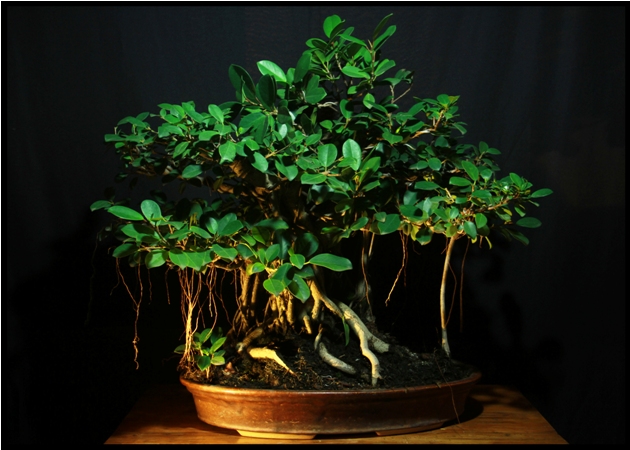
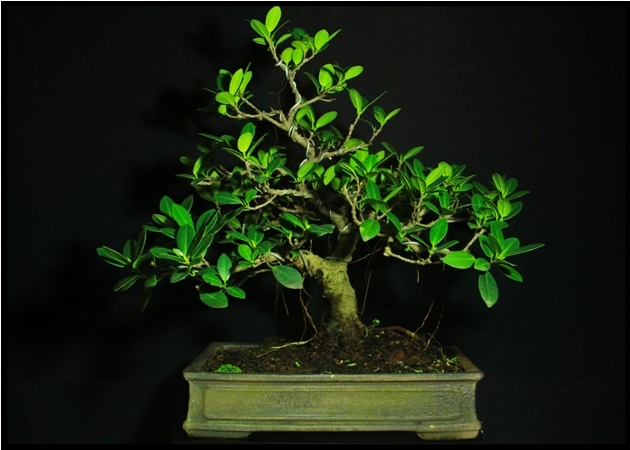
Ficus Compacta

At one stage or the other, every bonsai which has been in the same pot for a long time will be required to be repotted just as any potential bonsai will be required to be potted into a shallow, flat ceramic bonsai container for aesthetic purpose. Flat containers represent earth and are therefore desirable if a plant is to look like a bonsai tree. The pot for bonsai is like a frame to a picture. The pot should complement the tree and not detract from its looks. It should therefore not be too ornate or shiny. It should also be in proportion to the bonsai – not too big otherwise the tree will look comparatively smaller and will not give the impression of a big tree no matter how good it is, nor should it be so small that it will look visually unbalanced when compared to the bonsai.

The process of potting is as follows:

a) A suitable bonsai pot is chosen for the tree which is to be potted. The pot should neither be too big nor too small but should be big enough to accommodate the root ball and look appropriately balanced considering the future growth of the tree.

b) The pot is prepared by fixing pieces of netting on the drainage holes with the help of wire. If the tree is to be transported to another place after potting or if it is very tall or heavy and is liable to be shaken by strong winds or if it is feared that the rootage is inadequate, the tree will need to be tied into the pot. For this, insert a length of aluminum wire through the drainage holes so that the ends of the wire stick out of the pot from above. A small quantity of bonsai soil is poured on to the base of the pot and mounded where the tree is likely to be placed.

c) The tree which is to be transplanted in the bonsai pot is first wired if necessary. It is then taken out of the nursery pot in which it is and the soil from the periphery of the root ball is loosened bit by bit. Tangled roots, heavy roots and dead or rotted roots are trimmed off leaving a healthy, fleshy and compact root ball intact. Depending on the species, not more than about one-third to one half of the roots are trimmed off. The base of the root ball is also reduced, if necessary and the root ball is tried for fit in the pre-chosen bonsai pot.

d) Set the root pruned tree in the pot spreading the roots over the mound of soil and rock the tree gently so that the tree settles comfortably. Put Cover the roots with more soil and using a blunt instrument like a chopstick or dibber, poke the soil working it gently into the nooks and crannies between the roots but not in the compact root ball. Stop poking when the tree stops rocking if gently pushed and it appears to be stable. Pour more soil so as to cover any hanging roots and tamp the sides of the pot with the hand to settle the soil. The soil level near the edges of the container should be slightly below the rim of the pot.

e) Set the pot in a basin full of water which reaches just below the rim of the pot. Water will rise by capillary action and moisten the soil. Also spray the foliage of the tree with clean water to wash off any dust and also to provide it with extra humidity.

f) Remove the pot from the basin of water after about 15 minutes and set it in a shady place where it will get partial sunlight, away from winds and direct sun. Gradually, after about a fortnight when new growth is evident, expose the tree to more sunlight in increasing stages.

g) The success of the survival of the newly potted bonsai is in not watering it after the first watering till the soil is just dryish damp. Instead spray the foliage at frequent intervals to conserve moisture. A good alternative would be to provide the tree with a misty micro-climate in a green house or under a closed plastic covering with just enough ventilation to prevent saturation.


Repotting is similar to potting except that in repotting a tree is transplanted from a smaller bonsai pot to a larger pot or sometimes into the same or similar sized pot.

(Tip: Conifers are difficult to transplant in the tropical climates so it is better not to disturb their root balls at all and transplant them in a cooler season or in the rains).

Perceptions & Perspectives in Bonsai Design

PERCEPTIONS and PERSPECTIVES in BONSAI DESIGN

(part of my article entitled: The Living Art of Bonsai)

By definition a bonsai is a miniature tree planted in a tray or dish, evoking the majesty and beauty of a venerable old tree in nature with all its attributes such as tapering trunk, all round branch spread and a ground – gripping root flare. The whole concept of designing a bonsai revolves around the central idea of developing a plant into a tree which will display all the above attributes albeit on a miniature scale.

But all trees in nature are not impressive enough; many of them are young & immature and not so shapely. Trees which merit the adjectives old, majestic or beautiful are seen to have a bole which emerges from a root flare which appears to grip the soil firmly giving the first inkling of old age; there is a gradual transition from the powerfully impressive bole to a trunk breaking out into spreading branches which become smaller and thinner as the trunk tapers gradually to an apex of small branchlets. The tree appears balanced and graceful in its given setting. That is the aim in creating a bonsai-a balanced, graceful yet mature tree on a miniature scale, created through art, horticultural science and patience.

At the core of the art of bonsai therefore, are two interdependent factors: the perception of a potential tree form in the raw material and the conversion of this raw material into a recognizable tree form by means of horticultural skills.

INSPIRATIONS FROM NATURE

Since the design of bonsai depends on the designs of natural trees it is necessary, in order to design a bonsai, to know what key factors influence the shape and design of trees in nature. All trees have genetic characteristics peculiar to their species and are recognized by the distinctions in the following physiological factors:

Trunk Definition: The shape, inclination and movement of the trunk defines and distinguishes the style which is basically a classification of the different genetic tree forms seen in nature – thus a tree with a straight trunk is stated as having a Formal Upright style, a curved trunk denotes the Informal Upright style, a tree with a downward slanting trunk is called a Semi-cascade style, a trunk plunging way down indicates a Cascade style, a tree with a slanting trunk has a Slanting style, no fixed trunk direction for a Bunjin style, a tree with a trunk amp; branches sweeping in one direction is known as having the Windswept style and a straight trunk with branches emerging from one point is called the Broom style – all these styles have a trunk line with specific shapes and movement which gives the tree its special character.

Branch Silhouette and Root Flare: The silhouette of the tree also depends on the spread and arrangement of the branches and their periphery denotes a specific outline. Formal Upright, Informal Upright, Slanting, Cascade / Semi-cascade and the Windswept style will have an alternate left-right branch arrangement and a triangular outline whereas the Windswept and Broom styles will have a more rounded silhouette. A tree with a straight trunk (Formal Upright style) will have straighter branches with an alternate left-right arrangement although they may be slanted at a downward angle and its roots will disappear into the soil sloping down conspicuously on both the right and left sides. The silhouette will therefore be triangular and flow along the left-right axis. A tree with a curved trunk (Informal Upright style) is more convincing if the branches are also curved and sweeping and the roots are slightly up-curved before they disappear into the soil. Again, the branch arrangement is seen along the left-right axis and the roots too are conspicuous on both the right and left sides. If the trunk of a tree is slanting (Slanting style) the branches should appear to reach out away from the tree as if they are doing a balancing act and the roots should also reach out to the side opposite the lean. The trunk & branches in the Windswept tree design follow the wind direction although occasionally the trunk may lean into the wind. The silhouette is therefore almost triangular but somewhat softer, its outline defined by the extreme unidirectional sweep of even the branches growing from the opposite side. The roots grow more prominently in the direction opposite its lean as the tree counters the wind pull by growing stronger roots in that direction. The Broom style will have branches growing in all directions and a root flare to match. In other words, in any style, a critical design balance is achieved because the trunk direction & movement, the arrangement and sweep & sway of the branches and the positioning of the roots are in perfect co-relation with each other. It is this co-relation and the perspective between the three physiological factors which differentiates the impressive trees from the ordinary ones.

On the other hand, a lack of unity between these three physiological aspects will not make for a convincing & impressive tree image but will look more like a quirk of nature. For example, when the tree has a wavy, swaying trunk which projects femininity, then straight perpendicular branches emerging at almost right angles to this trunk and stiff & straight surface roots will look utterly out of place; a straight trunk which projects a masculine image will look incongruous if it is coupled with wavy, undulating branches and wavy amp; thin or puny surface roots. Similarly, a tree in a parkland setting which does not have to compete with other trees will look incongruous unless it is complimented by a virtually symmetrical spread of branches and a strong surface root flare radiating in all directions. A tree with branches sweeping to one side will look odd if it does not lean into or away from the wind direction and the surface roots do not grow strongly in the direction opposite its lean. A tree with peeled bark and branches will rarely show lush, luxuriant foliage; its foliage will normally show the ravages of the forces in their shorter branching & sparse foliage and its roots will be visibly strong enough to withstand the strong natural forces. In other words, exceptions to lack of unity in these physiological aspects are a rarity than a regular feature in nature.

The shapes of trees in nature are defined genetically but their designs are influenced by their environment and by natural forces. Thus a tree standing alone in a parkland setting and in a moderate climate will have a staid form irrespective of its genetic shape; a tree which has to compete with other nearby trees for sunlight and water may have a curving trunk or a dwarfed stature; grouped trees have to grow in a naturally upright habit as the crowding of trunks does not allow trunk deviation except for trees standing on the periphery of the group which are inclined to swing outwards & away from the main body of the group. A tree under the constant pressure of strong winds or stormy weather will show the effects of these natural forces in its dynamic design with a swirling trunk and wind-lashed branches or in the peeled & stripped bark and gnarled trunk showing a lot of deadwood. So, genetics dictate the trunk configuration but the environment influences their design distinctions.

The human brain has unlimited capacity to store impressions of things which we see, hear or feel. Dynamics such as culture, learning, information, other aesthetic qualities & values, experience, as also religion and philosophy, etc., influence our perceptions of things allowing the human brain to perceive and interpret things accordingly. Trees with impressive physiological features i.e., trunk movement, placement of branches & their silhouette and exposed root flare seen in nature portray the universal precepts of majesty, beauty and gracefulness and such exquisite characteristics positively impress the sub-conscious and the impressions formed thereby are indelibly incised in the human memory and stored for future reference. When the dynamics of perception and imagination are applied to these images from memory, the physiological aspects are enhanced and impressive real-life images are employed by human endeavor to create idealistic versions of the natural tree images. In other words, the beauty and majesty in the tree forms seen in nature inspire the concepts of bonsai design and these are replicated by the bonsai artist by simulating the natural factors and settings using known and sometimes inventive horticultural skills and imagination.


QUEST FOR PERFECTION

Every tree, be it from a tropical or temperate climate is basically molded by its species and the special characteristics of its family. Bonsai are no exception to this generality. Strictly speaking though, bonsai are not blind copies of natural trees; rather, they are the distillation of the best and most beautiful attributes of the trees we see in nature. The artist employs his artistic ability and horticultural skills to exploit the perceived potential in the plant material to create a bonsai of his vision with all the physiological aspects in a scaled down perspective. It is the artists’ memory and skill which serve as tools in creating the ideal form in the bonsai in a given setting.

Given the physiological factors, the setting and the artistic ability of the artist, every bonsai has a story to tell; its style and setting will depict a history of either staid good fortune (reflected in its all-round and even growth) or of competition with other trees (reflected in frequent deviations in the trunk and/or unequal branches) or of harsh or stormy weather and turbulent times (reflected in windswept and/or whipped trunk and branches or peeled bark on trunk & branches and sparse foliage). But this will happen only when the bonsai, its container and setting move as a unit.

However, there are several factors which may go wrong in the planning of the bonsai design and bring about imperfections and inadequacies in the design of a bonsai:

Many a times a bonsai although it is designed conventionally with perfect branch arrangement etc., may not look perfect and the composition may lack beauty; a bonsai may sometimes fail to evoke any special feeling when we look at it. This may be because of a number of reasons: the bonsai may lack a focal point, its visual mass or silhouette and /or the trunk line direction & movement may be contradicting each other or its position in and articulation with the container might not feel correct. Sometimes the bonsai may outgrow its original design and grow in a way not envisaged by the artist, because, after all, it is actually Nature which grows the tree. Many a times a bonsai as a tree individually may be good to look at but the overall composition may still feel wrong if any one of the physiological aspects mentioned above is at variance with the style, taken together with its container and its setting therein.

Whenever a bonsai fails to make the visual impact it would make if all the aspects were in accord, its impression as a replica of a tree in nature is lost and it will appear to be less beautiful and less than perfect; a re-thinking of the design becomes necessary therefore, if the bonsai is to look beautiful & impressive and reach its full potential as a tree evokative of grandeur, majesty and to a degree, refined mysticism.

The following are suggested as possible design considerations for creating a perfect & beautiful bonsai. Of course, these are subjective and just suggestive, but they will help initiate re-thinking for a more suitable and possibly a better design of the bonsai. All factors and each individual case, however, should be considered in their overall perspective:

a) Creation of a focal point which catches the eye of the viewer; The focal point holds the attention and displays to advantage the strong points in the physiognomy of the bonsai. It may be anything: pecularities in the trunk, specific branch placement and ramification or in the case of conifers, the deadwood features. If a focal point already exists, it may need to be enhanced or displayed to its best advantage and full potential. The bonsai will appear impressive visually when its strong points are raised from obscurity and highlighted to their full potential.

b) The visual weight of branches and foliage mass which gives the bonsai its periphery & silhouette has to be adjusted suitably. For example, if the bonsai has a stormy setting, its visual mass cannot appear to be evenly distributed; some branches are bound to be shorter and some more volatile & explosive than others. If it is placed on a rock, its roots are bound to either hug the counters of the rock or flow down the slope of the rock and its branches are more likely to articulate with the counters of the rock as if they are affected and shaped by the lift of the wind, a factor which is of relevance in all mountainous landscapes. The visual weight of the foliage should be greater than the pot size but not so great that the bonsai will look like it will topple over any moment; at the same time the counters of the foliage should complement the trunk movement, size and placement.

The overall volume and structure of the foliage mass also depends on the type of the plant material, i.e., whether it is a conifer or a semi-deciduous / broadleaf evergreen. Further, coniferous varieties, especially those which are amenable to deadwood carving will look better with just the right amount of deadwood and just the right amount of foliage. Sometimes the deadwood can be overwhelming, overpowering and purposeless, looking as if it has been carved merely because the artist wishes to show deadwood; it gives a confused look to the bonsai. Deadwood features need to be arranged and carved suitably so that the bonsai portrays the image of a tree which has faced harsh climatic conditions & trying times. The volume of foliage and its structure also needs to be finely tuned and arranged suitably by careful wiring wherever necessary, to portray the particular image conjured by the deadwood.

In the case of semi-deciduous / broadleaf evergreen trees, which incidentally also sport powerful & heavy trunk/s, abundance of foliage will speak of a lush, rich and sometimes tropical climate and therefore such trees should be having ample masses of foliage and branches to portray that climate and the ramification would need to be heavy enough to justify the powerfully growing trunk and abundance of branches.

c) Many bonsai are seen to have the entire foliage in a single contiguous mass or with markedly defined branches bare of foliage for a short distance from the junctions but with foliage at their ends clipped in the shape of pom-poms. Such bonsai look artificial and unnatural. The foliage masses of trees in nature, when seen from afar may look contiguous, but viewed up close the gaps and de-structured nature of the foliage counters can be seen clearly. The bonsai, since they emulate natural trees and since they are viewed from near, should also have a de-structured look of naturally growing branches and foliage and although they are pruned whenever necessary to keep the overgrowth in control, they should not have bunched up pom-pom like foliage. Artificiality can thus be avoided.

d) A bonsai design is primarily a composition of the tree and its container. Both the tree and the container need to compliment and co-relate to each other in the first place. The placement and the angle of articulation also are important and therefore particular attention needs to be paid to them when designing/redesigning a bonsai. The container also plays an important part in the aesthetics of bonsai design. A visually heavier or bigger pot in comparison to the foliage mass has the negative effect of making even perfectly beautiful trees appear insignificant. The largest dimension of the pot whether its length or height, when they are visually smaller than the branch spread will display & highlight the dimensions of the tree. In most cases, a flatter pot is visually more appropriate than a deeper pot simply because it has a horizontal surface representing earth and again because it’s visual weight is reduced to the thickness or height of the pot and would automatically appear visually smaller than the bonsai. The suitability of the geometric shape of the pot in relation to the style of the tree also needs to be considered carefully. The placement of the tree too should have a say in the bonsai design. The centrally off-center placement of the tree enhances the stability and balance of the tree. The positioning of the tree & the angle of the trunk as it emerges from the pot has a specific articulation with the horizontal surface of the soil and has a vital role to play in defining the style of the bonsai and in the overall visual impression of the bonsai.

The artist’s efforts are to be necessarily directed to using his skills and his imagination to simulate the impression of a venerable old tree irrespective of its actual age. It is the skill of the bonsai artist which, through the application of refined horticultural skills and imagination puts all the relevant factors of the bonsai design in their proper perspective and reveals in time the innermost beauty of the bonsai and breathes the spirit of a natural tree into it. But the skill and imagination of the artist are a variable factor, differing from person to person and one environmental setting to the other. The bonsai artist therefore needs to constantly seek ways to improve and hone his skills and upgrade his knowledge to be able to impart the natural grace, balance and feel to bonsai which makes them beautiful and perfect.

To sum up, there should be an agreement between the following three vital physiological factors: – 1) trunk definition; 2) branch silhouette; and 3) root flare. The shape of the trunk which determines the style, the branching pattern which describes the silhouette of the tree and rootage flare indicating the transition of the roots into the trunk – all these have a role to play.

The words of Master John Naka, doyen of bonsai, saying “Do not make your tree look like a bonsai, make your bonsai look like a tree” are pertinent in this respect and in a nutshell, they reflect the quintessence and philosophy of bonsai design.